
Women Historians’ Atlanta Walking Tour Shares the City’s Untold Stories
Last Updated February 26, 2026
Add Discover ATL as a preferred source on Google
Atlanta has so many famous people — Civil Rights leaders, business icons, celebrities, athletes — but what about regular people doing amazing things? Or even regular people doing regular things? Well, we have them — thousands of them — but their stories aren’t always told.

That’s about to change with History Afoot Atlanta, a new tour agency that introduces the voices of people who are often overlooked, such as women in the early 20th century entering the workplace and claiming their place in society, as well as the stories of journalists, politicians and other well-known people.
History Afoot Atlanta was founded by two women, Lisa Flaherty and Amy Durrell, both with backgrounds in historical preservation from Georgia State University and an intense desire to tell the stories of Atlanta and its amazing people. The tagline says it all: “We offer walking tours showcasing what exists now, what came before and how they came together.”

“We want to pull in as many voices as possible and as many places as possible,” Durrell said. “We’re putting faces in areas where you don’t normally go or think about what happened there. When I’ve gone on many history tours, I realized that, at some point, they were only talking about men, white men. I wanted to see myself in that landscape. Our goal is to talk about everyone.”
The two offer a variety of walking tours, including a hard hat tour of the 1882 Rich’s building that includes information about the department store’s importance to generations of Southerners, from the Lighting of the Christmas tree to the popular Magnolia Room.

Other tours include “Old Fourth Ward and the Beltline: Work, Home and Civil Rights Roots;” “A Transportation City: Atlanta and Aviation;” “Ponce City Market and the Beltline: Exploring Atlanta History;” and “Mid Century Women in Midtown Atlanta.” They also offer special tours, including “Seeing the 20th Century: Grand Spaces and Atlanta in Post-Civil Rights;” “Decatur Courthouse: What Do Those Monuments Mean Anyway?” and “Come One, Come All: A History of Atlanta Parades.”
Regardless of the exact tour taken, each features stories that connect people and integrate white and Black lives in the city. “We want to pull in as many voices as possible and as many places as possible,” Flaherty. said. “We talk about the tea houses that were introduced into the city [Mary Mac’s Tea Room in Midtown is the last one standing]. We’ll talk about Carrie Steele Pitts, who accomplished so much. (Carrie Steele Pitts, an African-American maid, pioneered one of the country’s first orphanages for African-American children. Today, it is still involved with aiding children and teens.) We talk about the Washerwomen’s Strike that a lot of people don’t even know about.”
The Washerwomen’s Strike took place in 1881 when African-American women who worked as domestic servants or washerwomen went on strike, demanding higher wages and better working conditions. They had to make their own soap, carry water from wells and then wash, boil and rinse the clothes before ironing them. They averaged between $4 to $8 per month. Twenty women went on strike, forming a union, the Washing Society, and demanded $1 per dozen pounds of clothes. Within weeks, more than 3,000 women went on strike, and other domestic workers, both in homes and hotels, joined. Eventually, the situation was resolved with the women being (mostly) satisfied.

Atlanta has “such great neighborhoods, and we’re a city of trees,” Durrell said. “We’re helping people see parts of Atlanta people don’t know about. We try to bring history back to life as we’ll talk about dancing. In the 20s, people were doing the bear hug dance or the turkey trot, and the school board barred kids from doing those crazy dances on the playground at recess.”
In addition to the tours, the women expanded their services, partnered with the Atlanta History Center to help celebrate its 100th anniversary, explored aviation’s impact on Hapeville at the Hapeville Depot Museum and shared South Downtown’s history and future.
The tours attract a variety of people. The aviation tour is largely male, but they’ve also had women on the tour to talk about engines, horsepower and the pros and cons of different airplanes. In South Downtown, investors are signing up not only to learn about the history but also to scout potential investments. “We also get a lot of people interested in the Ponce City Market tour because they’ve heard about it,” said Flaherty. “People just want stories about what was and how we got here.”
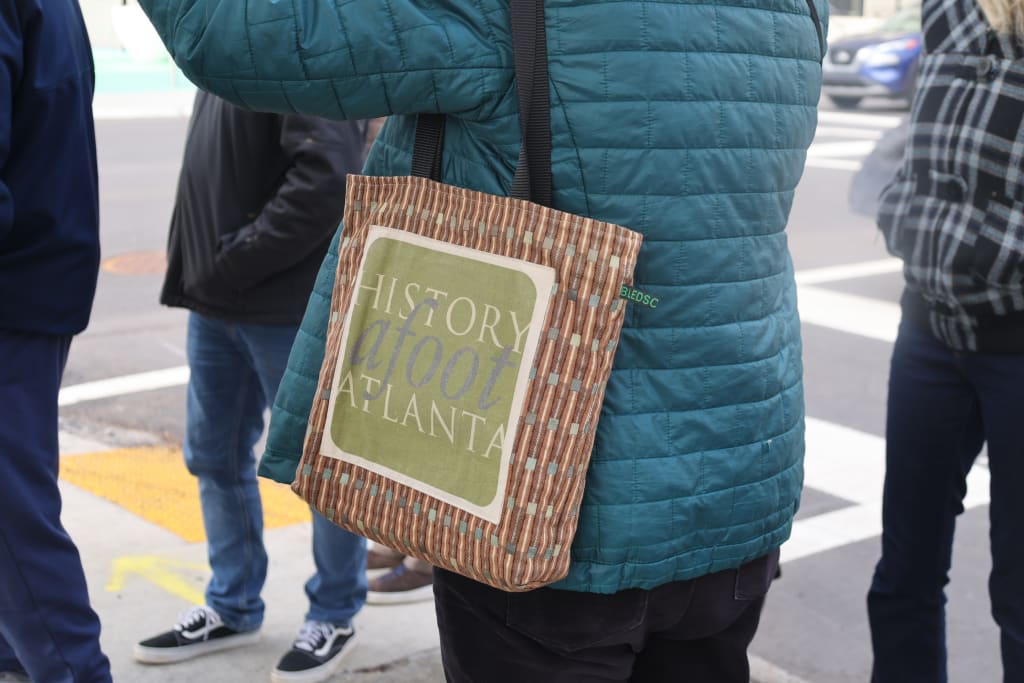
Tours are $30 per person and recommended for those 18 and older. Group prices are also available. The tours last between one and two hours and generally are about a mile in distance.
Discover more tours in Atlanta.

Mary Welch is an award-winning writer who has reported on the maturity off Atlanta’s culinary and hospitality scene as well as its growth as a sophisticated international city. Her byline has been seen in local and national outlets such as the Atlanta Journal-Constitution, Travelgirl, Global Atlanta, and American Lawyer covering topics such as travel, business, cars, law, hospitality and education. She co-authored a book with Chuck Leavell, the keyboardist for the Rolling Stones and a Georgia tree farmer, on the future of the American forest.
Originally Published February 25, 2026
Discover More
Get to know Atlanta, and discover the best things to do around the city.

