
Waffle House, an Atlanta Institution
Discover the history of Waffle House, learn the menu lingo and order like a regular at Atlanta’s most iconic diner.
Last Updated August 25, 2026
Add Discover ATL as a preferred source on Google
At a Glance:
- Founded near Atlanta in 1955, Waffle House now operates more than 2,000 locations across the U.S.
- The original restaurant in Avondale Estates is now a museum.
- Must try the iconic All-Star Special and customizable hash browns.
- Waffle House’s famous reliability inspired FEMA’s unofficial Waffle House Index.
- From road trips to late nights, discover why Waffle House is an essential Atlanta experience.

In a 2015 episode of “Parts Unknown,” Anthony Bourdain described Waffle House as “an irony-free zone where everything is beautiful and nothing hurts; where everybody, regardless of race, creed, color or degree of inebriation, is welcomed — its warm yellow glow a beacon of hope and salvation, inviting the hungry, the lost, the seriously hammered all across the South to come inside.”
It’s hard to improve on that. But spend enough time here, and you’ll understand it isn’t just a description — it’s a feeling. College students, blue-collar workers, road-tripping tourists and every kind of person converge under one roof at any given hour. Everyone has a story about Waffle House. Pretentiousness isn’t allowed around these parts. The laminated menus remain consistent, and the food doesn’t try to be anything other than exactly what it is. At the simplest level, Waffle House is an American-style diner. In reality, it’s a legendary institution.
Where It All Started
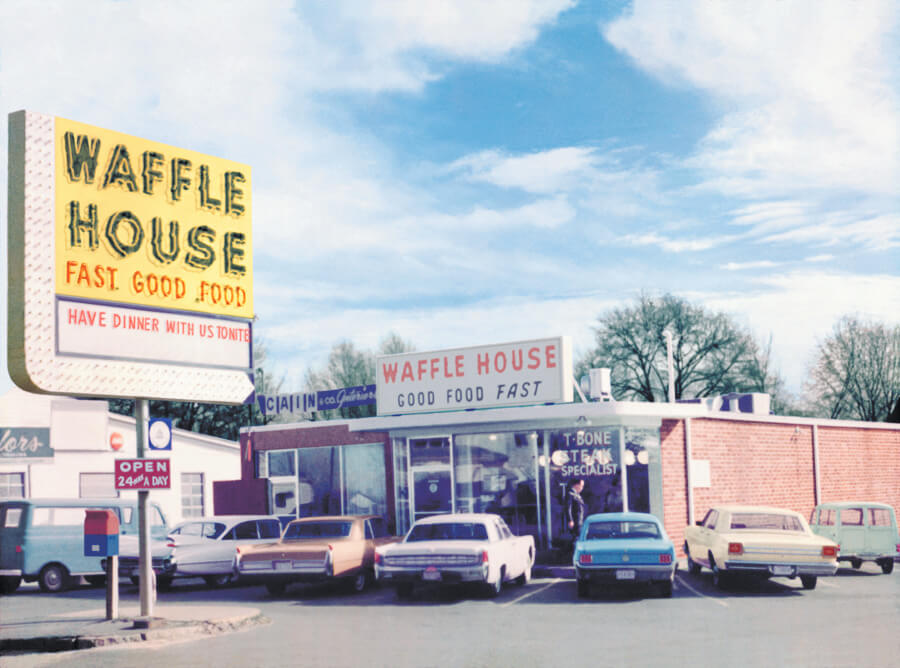
The story of Waffle House is, fittingly, an Atlanta story. Founded in 1955 in Avondale Estates — a small suburb just east of the city — by Tom Forkner and Joe Rogers Sr., the concept was simple: Serve breakfast foods, primarily waffles and hash browns, along with diner staples like patty melts and ham steaks, 24 hours a day, seven days a week. The name wasn’t accidental. Waffles had the highest profit margin on the menu, and the founders wanted to nudge customers toward it from the start. To this day, most Waffle Houses still operate on that schedule, with only some switching to late-night only hours and takeout.
The menu has remained largely the same since opening day, with only modest additions like biscuits and hash brown bowls over the decades. It wasn’t until 2006 — a full 51 years in — that Waffle House even began accepting credit cards. The cash-only policy had held firm across all operations, a stubbornness that somehow only added to the charm.
Today, Waffle House operates more than 2,000 locations across 25 states, concentrated heavily in the Southeast, with dozens of outposts across metro Atlanta. The original Avondale Estates location still exists and now operates as a museum available for guided tours by appointment. But the spirit of that first location lives on in every other one: counter seating facing the open grill, booths lining the windows and a layout so consistent that if you stripped all the coloring and lettering off a Waffle House, you’d still know exactly where you were.
More Than Just Breakfast
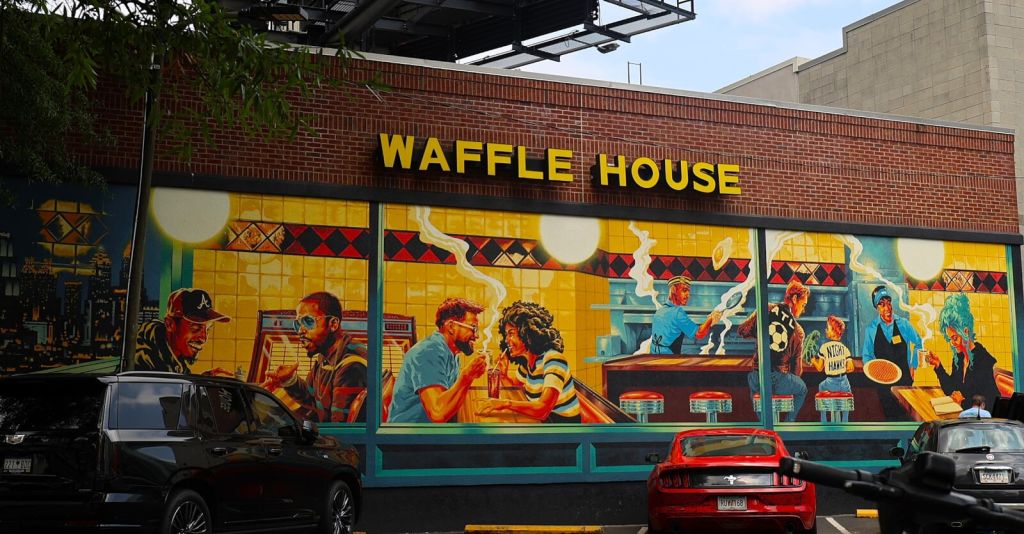
Part of what makes Waffle House so embedded in Southern life is its reliability. FEMA even uses an informal “Waffle House Index” to gauge the severity of natural disasters: Code Green means restaurants are fully operational; Code Yellow means limited menu service with possible power outages; Code Red means the location is closed — and things are very bad. In the South, where strong spring storms and Gulf of Mexico hurricanes are a reality, that index carries real weight.
And we can’t forget its imprint on music, including Atlanta. In “Welcome to Atlanta,” Jermaine Dupri raps: “After the party it’s the Waffle House/If you ever been here you know what I’m talkin’ about.” Plenty of other artists have done the same — namedropping it in lyrics and album titles as shorthand.
How to Actually Eat There
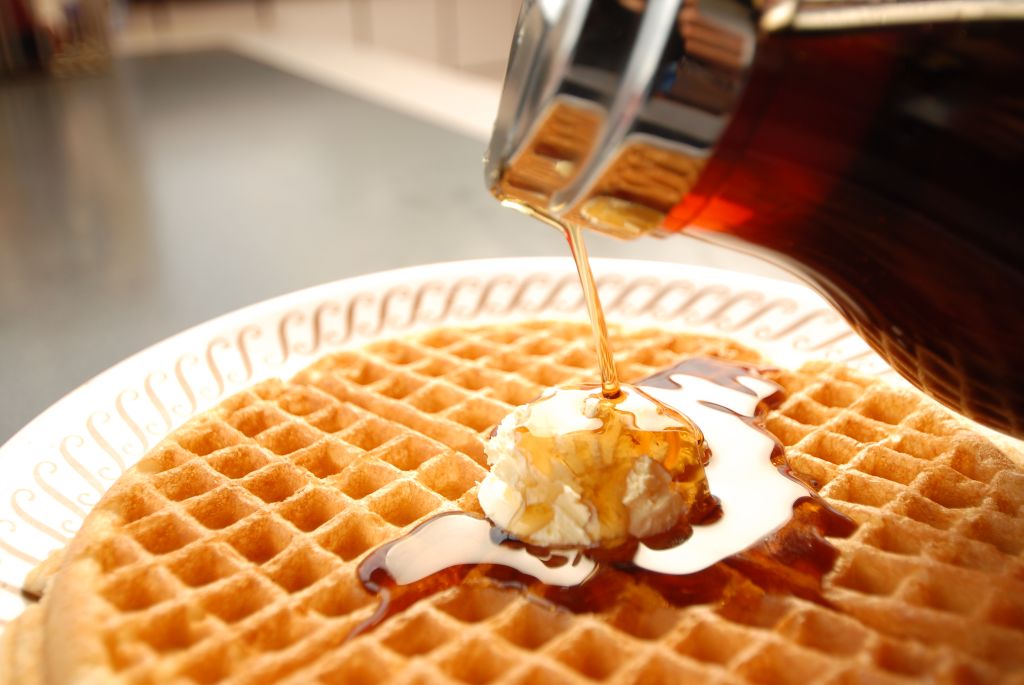
If it’s your first visit, the menu will require a brief orientation. Waffle House has its own language, and the fluency gap is real.
Walk in without any context and “scattered, smothered, and covered” will mean absolutely nothing to you. Scattered means the hash browns are spread directly across the grill (rather than cooked in a steel ring) so they crisp up evenly on all sides — it’s the most commonly requested modification and, honestly, the right call. From there, the toppings stack up: smothered (sautéed onions); covered (melted American cheese); chunked (ham); diced (tomatoes); peppered (jalapeños); capped (grilled mushrooms); topped (chili); or country (sausage gravy). Many regulars also ask for them well done for extra crispiness (believe me, no one can achieve this level of crispiness elsewhere).
As Charleston chef Sean Brock put it during that same Bourdain visit: “You can’t go all in, even though you want everything. There’s a balance. When you find your balance, you memorize it.” There’s truly a balance; this is the one time I’ll encourage you to be a little stingy with your order and not go all the way.
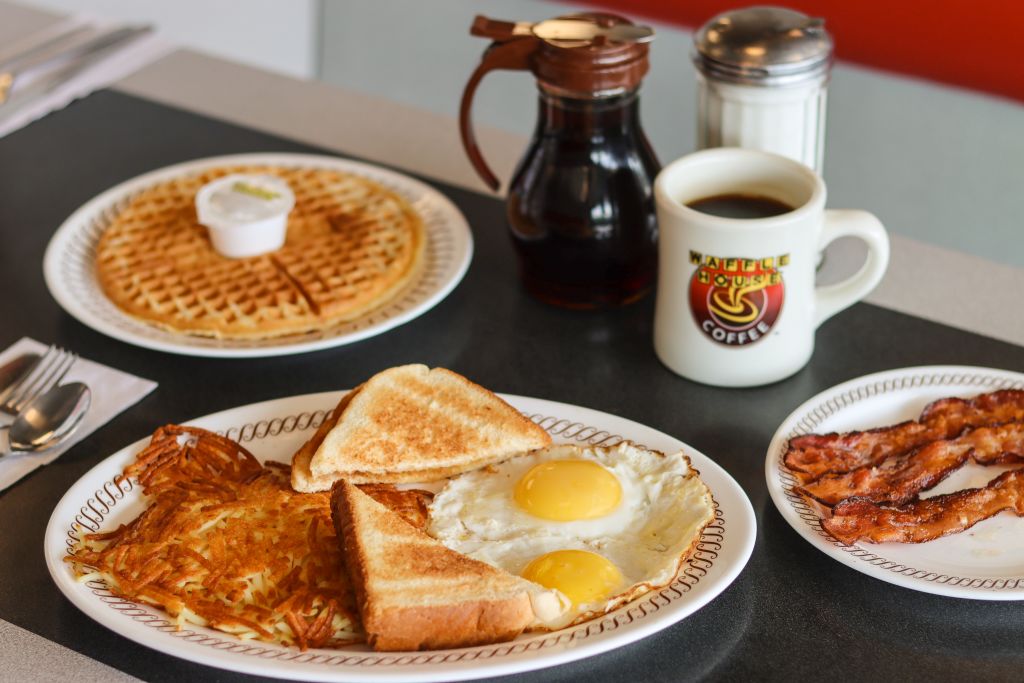
As a first-timer, there’s only one option for your first order: the All-Star Special. It’s essentially the full breakfast menu in one order — a classic waffle, two eggs (cooked however you’d like), toast, hash browns or grits, and your choice of bacon, sausage or ham. Despite inflation, it remains at $12.50, which is still a genuine deal. You can customize everything: egg style, toast type (the raisin toast is worth it), hash brown preparation, and protein. Add pecans or chocolate chips to your waffle if you’re feeling it. The All-Star Special is the move for anyone who wants to sample a little of everything before committing to a regular order.
Behind the counter, the choreography is worth watching. Grill operators use a system of “marks” to keep orders straight — condiment packets and small pinches of hash browns placed on plates in specific positions and orientations to signal which dish is which. It’s an entirely analog system that somehow works flawlessly during any meal rush.
WaHo Forever
The Waffle House at Glenwood Park sees me at least once a month. My current order: a pork chop cooked medium-well, two eggs over easy and hash browns smothered and covered. There’s a particular satisfaction in ordering this at 9 a.m. on a Saturday or 11 p.m. on a Tuesday and hearing the server call it back to the cook — who has a full grill going and doesn’t miss a beat.
That’s the thing about Waffle House. It rewards regulars with the comfort of a standing order and welcomes newcomers with a menu that meets you exactly where you are. Sobriety is not a requirement. Rudeness is not tolerated. The servers will make that clear efficiently and without much ceremony, and those who’ve seen it happen will tell you not to find out what that looks like firsthand.
The founders have passed on, but the institution they built holds steady — 24 hours a day, off interstates and on neighborhood corners across the South, under that warm yellow glow. If you’re visiting Atlanta, you’ll find it eventually. You might as well go in ready.
Discover more Only-in-Atlanta experiences in the city.

Originally Published June 24, 2026
Discover More
Get to know Atlanta, and discover the best things to do around the city.

